Missing Nukes: Treason of the Highest Order
Missing Nukes on August 29-30, 2007
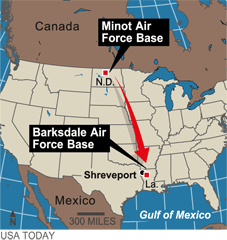
According to a wide range of reports, several nuclear bombs were “lost” for 36 hours after taking off August 29/30, 2007 on a “cross-country journey” across the U.S., from U.S.A.F Base Minot in North Dakota to U.S.A.F. Base Barksdale in Louisiana. [1] Reportedly, in total there were six W80-1 nuclear warheads armed on AGM-129 Advanced Cruise Missiles (ACMs) that were “lost.” [2] The story was first reported by the Military Times, after military servicemen leaked the story.
It is also worth noting that on August 27, 2007, just days before the "lost" nukes incident, three B-52 Bombers were performing special missions under the direct authorization of General Moseley, the Chief of Staff of the U.S. Air Force. [3] The exercise was reported as being an aerial information and image gathering mission. The base at Minot is also home of the 91st Space Wings, a unit under the command of Air Force Space Command (AFSPC).
According to official reports, the U.S. Air Force pilots did not know that they were carrying weapons of mass destruction (WMDs). Once in Louisiana, they also left the nuclear weapons unsecured on the runway for several hours. [4]
U.S. Air Force Deputy Chief of Staff for Operations, Plans, and Requirements, Major-General Richard Y. Newton III commented on the incident, saying there was an “unprecedented” series of procedural errors, which revealed “an erosion of adherence to weapons-handling standards” [5]
These statements are misleading. The lax security was not the result of procedural negligence within the U.S. Air Force, but rather the consequence of a deliberate tampering of these procedures.
If a soldier, marine, airman, or sailor were even to be issued a rifle and rifle magazine — weaponry of a far lesser significance, danger, and cost — there is a strict signing and accountability process that involves a chain of command and paperwork. This is part of the set of military checks and balances used by all the services within the U.S. Armed Forces.
Military servicemen qualified to speak on the subject will confirm that there is a stringent nuclear weapons handling procedure. There is a rigorous, almost inflexible, chain of command in regards to the handling of nuclear weapons and not just any soldier, sailor, airman, or marine is allowed to handle nuclear weapons. Only servicemen specialized in specific handling and loading procedures, are perm certified to handle, access and load nuclear warheads.
Every service personnel that moves or even touches these weapons must sign a tracking paper and has total accountability for their movement. There is good reason for the paperwork behind moving these weapons. The military officers that order the movement of nuclear weapons, including base commanders, must also fill out paper forms.
In other words,
unauthorized removal of nuclear weapons would be virtually impossible to accomplish unless the chain of command were bypassed, involving, in this case, the deliberate tampering of the paperwork and tracking procedures.
The strategic bombers that carried the nuclear weapons also could not fly with their loaded nuclear weaponry without the authorization of senior military officials and the base commander. The go-ahead authorization of senior military officials must be transmitted to the servicemen that upload the nuclear weapons. Without this authorization no flights can take place.
In the case of the missing nukes, orders were given and flight permission was granted. Once again, any competent and eligible U.S. Air Force member can certify that this is the standard procedure.
There are two important questions to be answered in relation to the "lost" nukes incident:
1. Who gave the order to arm the W80-1 thermonuclear warheads on the AGM-129 Advanced Cruise Missiles (ACMs)? At what level in the military hierarchy did this order originate? How was the order transmitted down the command chain?
2. If this was not a procedural error, what was the underlying military-political objective sought by those who gave the orders?
The Impossibility of "Losing" Nuclear Weapons
As Robert Stormer, a former U.S. lieutenant-commander in the U.S. Navy, has commented: “Press reports initially cited the Air Force mistake of flying nuclear weapons over the United States in violation of Air Force standing orders and international treaties, while completely missing the more important major issues, such as how six nuclear cruise missiles got loose to begin with.” [6]
Stormer also makes a key point, which is not exactly a secret: “There is a strict chain of custody for all such weapons. Nuclear weapons handling is spelled out in great detail in Air Force regulations, to the credit of that service. Every person who orders the movement of these weapons, handles them, breaks seals or moves any nuclear weapon must sign off for tracking purposes.” [7]
Stormer continues:
“Two armed munitions specialists are required to work as a team with all nuclear weapons. All individuals working with nuclear weapons must meet very strict security standards and be tested for loyalty — this is known as a ‘[Nuclear Weapons] Personnel Reliability Program [DoDD 5210 42].’ They work in restricted areas within eyeshot of one another and are reviewed constantly.”[8]
Stormer unwraps the whole Pentagon cover-up by pointing out some logical facts and military procedures. First he reveals that: “All security forces assigned [to handle and protect nuclear weapons] are authorized to use deadly force to protect the weapons from any threat [including would-be thieves].” [9]
He then points out a physical reality that can not be shrugged aside: “Nor does anyone quickly move a 1-ton cruise missile — or forget about six of them, as reported by some news outlets, especially cruise missiles loaded with high explosives.”
He further explains another physical and procedural reality about nuclear weapons assembly:
“The United States also does not transport nuclear weapons meant for elimination attached to their launch vehicles under the wings of a combat aircraft. The procedure is to separate the warhead from the missile, encase the warhead and transport it by military cargo aircraft to a repository — not an operational bomber base that just happens to be the staging area for Middle Eastern operations.” [10]
This last point raises the question of what were the nuclear weapons meant for? In this context, Stomrer puts forth the following list of important questions to which he demands an answer:
1. Why, and for what ostensible purpose, were these nuclear weapons taken to Barksdale?
2. How long was it before the error was discovered?
3. How many mistakes and errors were made, and how many needed to be made, for this to happen?
4. How many and which security protocols were overlooked?
5. How many and which safety procedures were bypassed or ignored?
6. How many other nuclear command and control non-observations of procedure have there been?
7. What is Congress going to do to better oversee U.S. nuclear command and control?
8. How does this incident relate to concern for reliability of control over nuclear weapons and nuclear materials in Russia, Pakistan and elsewhere?
9. Does the Bush administration, as some news reports suggest, have plans to attack Iran with nuclear weapons?
It is a matter of perception, whether it is “clear” or “unclear”, as to why the nuclear warheads had not been removed beforehand from the missiles.
For those who have been observing these series of “unclear” events it is becoming “clear” that a criminal government is at the helm of the United States. There was no way that the six nuclear missiles could have been “mistakenly” loaded, especially when their separate warheads had to be affixed to the missiles by individuals specialized in such a momentous task.
It is also being claimed that military teams in both U.S.A.F. Base Minot and U.S.A.F. Base Barksdale made major "procedural errors". What are the probabilities of this occurring simultaneously in two locations?
It is also worth noting that original reports from military sources talked about only five of the six nuclear warheads from Minot being accounted for in Barksdale.[11] Nuclear warheads are also kept in specialized storage areas or bunkers. Moreover, nuclear weapons are not being decommissioned at Barksdale.
The Role of the Nuclear Weapons Surety Program: What happened to Electronic Monitoring?
The Nuclear Weapons Surety Program is a joint program between the U.S. Department of Defence and the U.S. Department of Energy. The National Security Agency (NSA) is also involved as well as other U.S. federal government agencies. The Nuclear Weapons System Safety Program is part of this program, which involves a monitoring and safeguards regime for the U.S. nuclear arsenal.
The Nuclear Weapons Security Standard falls under the Nuclear Weapons Surety Program and is in place to disallow any “unauthorized access to nuclear weapons; prevent damage or sabotage to nuclear weapons; prevent loss of custody; and prevent, to the maximum extent possible, radiological contamination caused by unauthorized acts.”
Under this or these safeguards system there also exists a rigorous control of use scheme, which is tied to the military chain of command and the White House.
“Command and Control (C2)” and “Use Control”
“Use control” is a set of security measures designed to prevent unauthorized access to nuclear weapons. These measures involve weapons design features, operational procedures, security, and system safety rules.
“Command and Control” or “C2” involves the Office of the President of the United States of America. C2 is an established line of command, which is tied to the White House. Without it, nuclear weapons cannot be deployed or armed as they were in U.S.A.F. Base Minot. It is these two control elements that establish the basis of authorization through which “absolute control of nuclear weapons” is maintained “at all times.”
In addition to the checks and balances in place in regards to handling nuclear weapons, the Defence Threat Reduction Agency (DTRA) and its partners manually and electronically inspect and monitor all U.S. nuclear weapons through the Nuclear Weapon Status Information Systems.
More Unanswered Questions: What Happened to the Computerized Tracking System?
The Nuclear Management Information Systems “interface with each other and provide [the U.S. Department of Defence] with the ability to track the location of nuclear weapons and components from cradle-to-grave [meaning from when they are made to when they are decommissioned].” [12]
The Military Times also makes an omission that exposes the official narrative as false and indicates that the event was not just a mistake: “The Defense Department uses a computerized tracking program to keep tabs on each one of its nuclear warheads, said Hans Kristensen, director of the Nuclear Information Project at the Federation of American Scientists. For the six warheads to make it onto the B-52, each one would have had to be signed out of its storage bunker and transported to the bomber.” [13]
This is where the chain of command in regards to military officers falls into play. If any of the stocked inventories of nuclear weapons are moved to an authorized location they will be noticed and tracked by the DTRA and will require the relevant authorization. There is also a code system involved that is tied to the chain of command.
The fact that the incident only apparently became known to the U.S. Air Force when military personnel reported it, suggests that either the nuclear weapons were ordered to be moved or that the electronic tracking devices had been removed or tampered with. This scenario would need the involvement of individuals with expertise in military electronics or for those responsible for the monitoring of nuclear weapons to look the other way or both.
Mysterious Deaths in the United States Air Force: Whitewash and Cover-up
Several military personnel died under mysterious circumstances shortly before and after the incident. There are now questions regarding the fate of these individuals in the U.S. Air Force who could have had relationships in one way or another to the incident or possibly have been directly involved. It is also necessary to state that there is no proof that these deaths are linked to the August flight from Minot to Barksdale in question.
Citizens for Legitimate Government has pointed towards the involvement of the U.S. Air Force in a cover-up and has linked several deaths of U.S. servicemen to the incident. Lori Price has also stated for Citizens for a Legitimate Government that “you need about fourteen signatures to get an armed nuke on a B-52.”
Based on several news sources, including the U.S. military, we provide below a detailed review of these mysterious and untimely deaths of U.S. servicemen.
Todd Blue
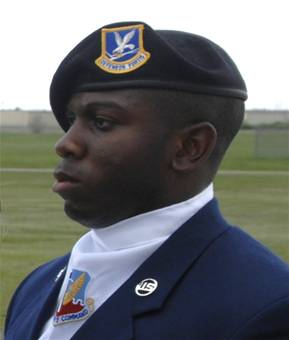
Airman 1st Class Todd Blue went on leave days after the nuclear weapons were “lost.” Blue died under questionable timing while on leave, visiting his family in Wytheville, Virginia at the age of 20 on September 10, 2007. He was a response force member assigned to the 5th Security Forces Squadron. What does this mean?
Airman Todd Blue occupied a key position in weapons systems security at Minot. [14] At Minot U.S.A.F. Base the 5th Security Forces Squadron to which he belonged was responsible for base entry requirements and a particular section, the Weapons System Security section, was responsible for preventing the unauthorized removal of military property. The latter is responsible for security of all priority resources, meaning the security of nuclear weapons. In other words not only did the 5th Security Forces Squadron keep eyes on what entered and left Minot, but they kept an eye on and monitored the nuclear weapons.
John Frueh
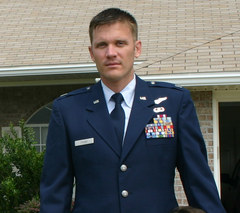
U.S. Air Force Captain John Frueh is another serviceman who could have been indirectly connected to the “lost” nuclear weapons. He was reported as being last seen with a GPS device, camera, and camcorder being carried with him in a backpack. Local police in Oregon and the F.B.I. seemed to be looking for him for days. His family also felt that something bad had happened to him.
On September 8, 2007 Captain Frueh was found dead in Washington State, near his abandoned rental car, after the Portland Police Department contacted the Skamania County Sheriff’s Officer. [15] The last time he spoke with his family was August 30, 2007. He had arrived from Florida to attend a wedding that he never showed up at. The Oregonian reported that “Authorities in Portland found no activity on his credit or bank cards since [Frueh] was last seen (...) [and that] the last call from his cell phone was made at 12:28 p.m. [August 30, 2007] from Mill Plain Boulevard and Interstate 205 in Vancouver [Washington State].” [16]
His background was in meteorology and the study of the atmosphere and weather. He was also reported to be a U.S. Air Force pararescue officer. [17] He was also a major-select candidate, which means he was selected for a promotion as a U.S. Air Force major, but was not officially promoted.
Captain Frueh belonged to the U.S.A.F. Special Operations Command. U.S.A.F. Special Operations Command has its headquarters in Hurlburt Field, Florida and is one of nine major Air Force commands. It is also the U.S. Air Force’s component of U.S. Special Operations Command, a unified command located at MacDill Air Force Base, which is also in Florida. The force provides special operations forces for worldwide deployment and assignment to regional unified commands, such as CENTCOM. Its missions include conduct of global special operations. These operations — and this is where careful attention should be paid — range from “precision application of firepower, such as nuclear weapons,” to infiltration, exfiltration (the removal of “devices,” supplies, spies, special agents, or units from enemy territory), re-supply and refuelling of special operational elements.
In Captain Frueh’s case his death is questionable too. The U.S. Air Force would not let a missing persons’ investigation go forward by the police without conducting its own investigation. Usually the different service branches of the U.S. military would investigate for missing servicemen, to see if these individuals are Absent Without Authorized Leave (AWAL) or have deserted, before an individual’s case is handed over to the police.
Clint Huff, Linda Huff, and Weston Kissel
Another military weatherman, along with his wife, also died after August 30, 2007.
Senior Airman Clint Huff, belonging to the 26th Operational Weather Squadron and his wife
Linda Huff died in a motorcycle accident on September 15, 2007. [18] The husband and wife fatality happened on Shreveport-Blanchard Highway, near U.S.A.F. Base Barksdale, when according to the Caddo Parish Sheriff’s Officer a Pontiac Aztec, a medium-sized SUV, initiated a left turn at the same time that the couple attempted to pass on a no passing zone and collided. [19]
 |
| First-Lieutenant Weston Kissel |
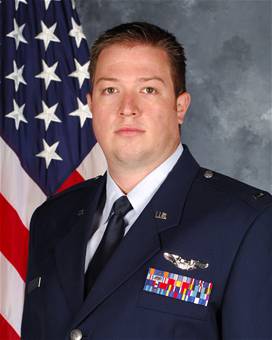
First-Lieutenant Weston Kissel, a B-52H Stratofortress Bomber pilot, also died in a reported Tennessee motorcycle accident. This was while he was on leave in, less than two months from the nuclear B-52 flights, on July 17, 2007. [20] His death came after another single-vehicle accident by another Minot serviceman, Senior Airman Adam Barrs. [21]
Adam Barrs and Stephen Garrett
Senior Airman Barrs died as a passenger in a vehicle being driven by Airman 1st Class Stephen Garrett, also from Minot. Garrett, also belongs to the 5th Aircraft Maintenance Squadron.
The death of Barrs was reported as being part of a single-vehicle car accident. Associated Press reports state that “[Minot] Base officials say 20-year-old Barrs was a passenger in a vehicle that failed to negotiate a curve, hit an approach, hit a tree and started on fire late Tuesday [July 3, 2007] night.” [22] Barrs was pronounced dead on the scene of the accident, while Garrett was taken the hospital with no updates released by the U.S. Air Force. Adam Barrs also belonged to the 5th Aircraft Maintenance Squadron, where he was responsible for the maintenance and securing of the electronic communicational and navigation mission systems aboard the B-52H Stratofortresses on base. The 5th Aircraft Maintenance Squadron is also one of the units that are responsible for loading and unloading weaponry onto the B-52H Stratofortresses.
The deaths of Kissel and Barrs could be dismissed as irrelevant because they occurred prior to the incident. However, Barrs and Kissel could have been in one way or another connected to the advanced planning of the special operation, prior to the incident (special operations are not planned in a few days and may take months and even longer). There is, of course, no proof and only an independent investigation will be able to reveal whether these deaths are connected to the incident.
If there was an internal and secretive operation bypassing most military personnel, a few men in key positions would have to have been involved over a period of time prior to the August 29/30, 2007 flight. Senior Airman Barrs, due to his expertise in communication and navigational systems, could potentially have been involved in the preparations that would have allowed the nuclear weapons to escape detection by military surveillance and be ready for takeoff.
Reprimands, Replacements and Reassignments in the U.S.A.F. Chain of Command
Senior officers, including three colonels and a lieutenant-colonel, are among seventy personnel that will reportedly be disciplined for negligence and for allowing a B-52H Stratofortress Bomber to fly across the U.S. carrying six nuclear-armed cruise missiles that should never have been loaded under its wings. [23]
According to the Military Times, George W. Bush Jr. had been swiftly informed. This is a lockstep procedure. This illustrates the importance tied to the authorization needed for handling nuclear weapons. This is part of a two-way process in regards to authorization from the White House.
The commander of the 5th Munitions Squadron and the commander of the 5th Bomb Wing, Colonel Bruce Emig, have been replaced along with a series of other senior officers. This implies that the U.S. Air Force chain of command is directly involved in this event. None of these senior officers have been authorized to speak or make statements, according to U.S. military sources. Will any of these officers receive lucrative departure packages? Have they been reassigned?
More generally, the nature of the reprimands directed against senior officers involved has not been fully disclosed.
The “memory” of the incident is being erased through a reorganization of the ranks and a purge at U.S.A.F. Base Minot. The streamlining of the chain of command as well as the mysterious deaths of personnel who could have been involved in the incident, raise a series of far-reaching questions.
There are several important issues regarding the senior officers’ chain of command at Minot, which will be addressed in this article. Once again, the most important questions in regards to the missing nukes are:
Who gave the orders and authorization for the operation and
what where the underlying objectives of loading armed nuclear missiles?
Other Mysterious Deaths: Was the Missing Nukes Incident connected to US War Plans directed against Iran?
Charles D. Riechers
A U.S. Air Force official,
Charles D. Riechers, has been found dead on October 14, 2007. [24] Riechers was a retired Air Force officer and master navigator specializing in electronic warfare. He was a member of the Senior Executive Service of the U.S. Air Force, and was the Principal Deputy Assistant Secretary of the Air Force for Acquisition and Management. A description of his duties includes “providing sound expert advice and guidance on acquisition and procurement policies, as well as formulating, reviewing and, as assigned, execution of plans, programs and policies relating to organization, function, operation and improvement of the Air Force’s acquisition system.”
He apparently killed himself by running his car’s engine inside his suburban garage in Virginia. The death of Charles D. Riechers has been casually linked by
The Washington Post to his involvement in fraudulent activities and embezzlement. [25]
The Washington Post reported that the Air Force had asked defense contractor, Commonwealth Research Institute (C.R.I.), to give him a job with no known duties while he waited for official clearance for his promoted rank in the Pentagon. Riechers is quoted as saying: “I really didn’t do anything for C.R.I.,” and “I [still] got a paycheck from them.” The question, of course, was whether the contractor might expect favours in return upon his assignment to the Pentagon last January. [26] A mysterious suicide letter expressing shame was subsequently reported; the letter was reportedly from a man who had already admitted without shame that he was receiving money for doing nothing. This was known to the U.S. Senate, which had approved his promotion.
In a report featured by
Pravda, Russian Intelligence analysts have said that the reported suicide of Charles D. Riechers was a cover-up and that he was murdered because of his involvement in the controversial flight of nuclear weapons over the continental United States.
Pravda reports that “Russian Intelligence Analysts are reporting today that American War Leaders have ‘suicided’ [sic] one of their Top U.S. Air Force Officials Charles D. Riechers as the rift growing between the U.S. War Leaders and their Top Military Officers over a nuclear attack on Iran appears to be nearing open warfare.” [27]
According to the Pravda report, the incident was linked to an operation to smuggle nuclear weapons away from the U.S. military in connection to launching a war against Iran.
The Commonwealth Research Institute (CRI), a registered non-profit organization is a subsidiary of Concurrent Technologies, which is registered with the IRS as a tax-exempt charity, which is run by Daniel Richard DeVos. Devos is also an associate of John P. Murtha, who was investigated by the F.B.I. for his Saudi links.
Certainly the ties of the Commonwealth Research Institute (CRI), a non-profit organization working for the Pentagon, are questionable and the organization could be a front for internal operations that bypass most military personnel. The case appears to be part of an internal operation that was being kept a secret from most of the U.S. military, but what for?
Russell E. Dougherty
More than a month before the death of Riechers,
General Russell Elliot Dougherty, a retired flag officer, was also reported to have died on September 7, 2007 at his home in Falcon Landing military retirement community in Potomac Falls located in Arlington, Virginia. [28] He once was one of the most senior individuals responsible for the nuclear arsenal of the U.S. military and also the former commander of Strategic Air Command (SAC) and director of the Joint Strategic Target Planning Staff, which identified nuclear targets worldwide amongst its responsibilities. At Minot next to his obituary was a military information notice on suicide, telling servicepersons what the signs of suicide are. [29]
Russell Dougherty in the course of his military career in the U.S. Air Force had dealt with the issues pertaining to Mutual Assured Destruction (MAD), full spectrum dominance, how to defeat the enemy and avoid a nuclear war, other uses for nuclear weaponry, Nuclear Primacy for the U.S., and tackling the effects of the wind and weather — due to their unpredictable natures — on the use of nuclear weapons.
The fact that the nuclear warheads were attached to the nuclear cruise missiles could mean that someone wanted to take the weapons in one step or to use them right away.
Timely Appointments at U.S.A.F. Base Minot
Several of the commanding officers at Minot were freshly appointed in June, 2007. This may have been part of standard procedures, but the timing should not be ignored.
Colonel Robert D. Critchlow was transferred, just before the incident, from the Pentagon to Minot and appointed commanding officer for the 91st Operations Group, a missileer unit and the operational backbone of the 91st Space Wing. In Washington, D.C. he was involved in research for the Congressional Research Services and later posted into Air Force Nuclear Response and Homeland Defence.
Colonel Myron L. Freeman was transferred from Japan to Minot in June, 2007. Colonel Freeman was appointed as the commander of the 91st Security Forces Group, which is responsible for securing Minot’s nuclear arsenal.
Colonel Gregory S. Tims was also appointed as deputy commander or vice-commander of the 91st Space Wing in June, 2007. However, Colonel Tims was transfered to Minot from California almost a year before.
One of the most senior non-commissioned officers (NCOs) or non-commissioned members (NCMs),
Chief Master Sergeant Mark R. Clark, was also transferred to U.S.A.F. Base Minot from Nebraska in July, 2007.
Colonel Roosevelt Allen was also transferred to Minot from Washington, D.C. to become commander of the 5th Medical Group.
Colonel Bruce Emig, the now-former commander of the 5th Bomb Wing, was also transferred to Minot from U.S.A.F. Base Ellsworth in South Dakota in June, 2007. Colonel Emig was also the base commander of Minot.
Colonel Cynthia M. Lundell, the now-former group commander for the 5th Maintenance Group, the unit responsible for loading and unloading weaponry onto the B-52H Stratofortresses was also freshly transferred from a NATO post in Western Europe in June, 2007. Were these appointments temporary? Were any of these appointments related to the six “lost” nuclear missiles?
Prior to the Missing Nukes Incident, Minot Airmen Meet with the President and the U.S. Air Force Chief of Staff
On June 15, 2007, George W. Bush Jr. met senior officers from U.S.A.F. Base Minot at U.S.A.F. Base McConnell in Wichita, Kansas during a visit to Boeing’s Integrated Defense Systems facility. Amongst them was Major Daniel Giacomazza of the 5th Operational Support Squadron.
Senator Patrick Roberts of Kansas was also present. “While he chaired the Senate Intelligence Committe from 2002 to 2007, [Senator] Roberts stonewalled attempts to investigate everything from the manipulation of intelligence in the rush to war in Iraq, President Bush’s warrantless wiretaps, and even allegations of the use of torture by the CIA,” according to Associated Press (AP) reports. [30] The same report also indicates that the U.S. President was in Wichita for a political fundraiser, and stopped at a new Boys and Girls Club of America to defray the costs of getting to Wichita via Air Force One for Senator Roberts’ campaign.

Military sources have reported that a B-52H Stratofortress was flown to Wichita so that Boeing’s engineers could take a look in order to make adjustments to the war planes for a new military program. [31] Nothing has been reported about any private meetings between President Bush Jr. or any of his presidential staff and the personnel from Minot. However, reports have been made of meetings between military families and the U.S. President in his office on Air Force One.
General Moseley, the Air Force Chief of Staff, had previously visited Minot on
March 14-15, 2007, a month before Minot airmen went to Wichita. [32] If a secret mission was being prepared, these events could have played a role in the recruiting phases for an important internal special operation. Following their recruitment, Minot servicemen could have symbolically met General Moseley or White House officials to understand that the mission was being sanctioned by the highest ranks and offices in the United States.
Orders had to Come from the Top: Treason of the Highest Order
Orders had to come from higher up.
The operation would not have been possible without the involvement of more than one individual in the highest ranks of the U.S. Air Force command structure and the Pentagon.
The only way to bypass these separate chains of command is “to be above them” (from higher up), as well as to have the possibility of directly overseeing their implementation.
These orders would then have been communicated to lower levels in the U.S. Air Force command chain in different locations, to allow for so-called “oversight” to proceed. The alternative to this is “an alternative chain of command,” although this also needs someone in the highest ranks of office to organize and oversee.
The post given to Riechers was politically motivated, given his track record in the U.S. Air Force. Riechers had been in a position of responsibility in the U.S. Air Force special operational support activities; something he had in common with Russell Dougherty, the former SAC commander. He would have been one of the best suited individuals for making arrangements in the case of an alternative command structure for a secretive nuclear operation. Moreover, he already had a record of corrupt behaviour through his involvement with the Commonwealth Research Institute. The possible involvement of U.S. Air Force weathermen and special operatives raises many questions as to what exactly was the objective of making the nuclear weapons disappear. [33]
The Investigation
The U.S. Air Force has publicly stated that it has made a “mistake,” which is very unusual and almost unprecedented for a military organization that tries to continually assure the American public of their safety.
The fact that seventy or more military personnel have been punished in the case of the “lost” nuclear weapons does not mean, however, that the senior commanding officers responsible for having carried out the special operation will be identified and punished.
Quite the opposite. The investigation could indeed result in a camouflage of the chain of command, where lower-ranking military personnel are accused and court-martialed, with a view to ultimately protecting those in high office who have committed an act of treason.
The series of deaths mentioned above, may have no ties whatsoever with the the August flight in question from Minot to Barksdale, but the issues of command, monitoring, and authorization cannot be overlooked or ignored. The American people have before them a case of treason that involves the highest offices of government and most probably the offices of the President and the Vice-President.
Once again, the “C2” process involves the Office of the President and Commander-in-Chief. It is an established line of command, without which nuclear weapons could not have been deployed or armed as they were in U.S.A.F. Base Minot. It is this command element that establishes the basis of authorization through which “absolute control of nuclear weapons” is maintained “at all times.”
With time it is possible that military servicemen and servicewomen may come forward with more information.
However, in the meantime, there has been a streamlining of military personnel at U.S.A.F. Base Minot. Base personnel have become dispersed and reassigned to other locations.
If they on the grounds of loyalty to their country, the United States of America, come forward and reveal what has taken place, they are to be saluted with full honour by all ranks. As George Orwell said, “In a time of universal deceit, telling the truth becomes a revolutionary act,” and indeed these are deceitful times.
The fact that U.S. Air Force officers came forward and reported this incident is contrary to U.S. military procedures, regulations, and laws. The U.S. military will never release any information that will risk or damage its reputation. Any information in regards to nuclear weapons can not be released without prior consultations with and authorization by the White House.
The nuclear weapons were armed and moved deliberately. Orders had to have come from the highest echelons of the U.S. government.
The question is what exactly were they meant for? Were they part of a war agenda or something else?
Bush Threatens Iran with Nuclear Weapons
What adds intrigue to an understanding of the missing nukes, are the international events and war games taking place just after the “lost” nuclear weapons incident, not to mention the President’s ongoing threats to attack Iran with nuclear weapons and Vice President Cheney's repeated warnings that a second large scale terrorist attack on America is under preparation, with the support of Iran.
In the U.S., under the Vigilant Shield 2008 war games (initiated in September, 2007) and the TOPOFF anti-terrorism exercises, some form of nuclear terrorist attack on American soil had been envisaged. The roles of Russia and China had also been contemplated. The latter would be “a likely scenario” had the U.S. attacked Iran and as a result Russia and China had decided to intervene. [34] Under Vigilant Shield 2007, held in 2006, the possibility of a nuclear war with Iran’s allies, Russia and China, had been contemplated in the war games scenario.
The Kremlin has responded by holding its own war games.[35]
An unveiled threat to trigger World War Three has been the response of George W. Bush Jr. to Russia’s statements warning that a U.S. sponsored war with Iran, could result in an escalating World War III scenario.
The six nuclear warheads were not meant for use in theatre operations against Iran. This is obvious because if they were then they would have been deployed via the proper procedural routes without the need to hide anything. Besides, there are already theatre-level nuclear weapons ready and armed in Europe and the Middle East for any possible Middle Eastern mission. There was something more to the incident.
It is also worth noting that the Israelis launched an attack on an alleged Syrian nuclear facility that both Tel Aviv and the White House claim was constructed with the assistance of North Korea. This event has been used, through official statements and media disinformation, to draw a Syria-Iran-North Korea nuclear proliferation axis. [36]
In regards to the case of the missing nuclear weapons, weathermen and military personnel with an expertise in space and missile components were involved. The incident took place during a time when the U.S. missile shield projects in Eastern Europe and Eastern Asia, directed against Russia and China, were raising international tensions and alarms. On October 23, 2007, President Bush Jr. stated: “The need for missile defence in Europe is real and I believe it’s urgent.” [37]
Nuclear warfare, the militarization of space, and “the missile shield” are interrelated military processes. The overtones of Nuclear Primacy are hanging in the air. One of the goals of the U.S. military has been to effectively shield itself from a potential Russian or potential Russian and Chinese nuclear response to a nuclear “First Strike” from the U.S. military. [38] The militarization of space is also deeply linked to this military project. Like their advanced knowledge about the U.S. missile shield project, Russian and Chinese officials have got wind of these ambitions and are fully aware of what the U.S. intends to do.
Mahdi Darius Nazemroaya is an independent writer based in Ottawa specializing in Middle Eastern affairs. He is a Research Associate of the Centre for Research on Globalization (CRG).
--------------------------------------------------------------------------------
NOTES
[1] Sarah Baxter,
US hits panic button as air force ‘loses’ nuclear missiles, The Times (U.K.),
October 21, 2007.
[2] The Nuclear Reactions Data Centres also estimated that the W80-1 stockpile included a total of 1,400 warheads remain in stockpile associated with the 900 ALCMs that are in storage with their warheads removed.
[3] Baxter,
US hits panic button, Op. cit.
[4] John Andrew Prime,
Barksdale bombers expand B-52 capabilities, The Sheveport Times,
August 27, 2007.
[5] Baxter,
US hits panic button, Op. cit.; Major-General Newton is also responsible for formulating policy supporting air, space, nuclear, counter-proliferation, homeland, weather, and cyber operations. Because of his role as one of the Air Forces’ key flag officers in regards to nuclear issues and counter-proliferation he has been involved in war planning in regards to Iran, Israeli preparations for attacks on Syria, and the 2006 Israeli war against Lebanon.
[6] Robert Stormer,
Nuke transportation story has explosive implications, Fort Worth Star-Telegram, Octobers 8, 2007.
[7] Ibid.; To help ensure adequate shipboard security, TLAM-N is protected by an intrusion detection alarm system that indicates an intrusion, both visually and audibly, at a continuously manned station capable of dispatching a security team.
[8] Ibid.
[9] Ibid.
[10] Ibid.
[11] Michael Hoffman,
B-52 mistakenly flies with nukes aboard, Military Times, September 10, 2007; Associated Press sources also made the same report. Military Times simply changed their article and AP withdrew its report on the basis of a factual error.
[12] Office of the Inspector General, U.S. Department of Defence (DoD),
Year 2000 Status of the Defense Threat Reduction Agency Nuclear Weapon Information Tracking Systems, Report No. 99-235 (August 19, 1999).
[13] Michael Hoffman,
Commander disciplined for nuclear mistake, Militarty Times,
September 7, 2007.
[14]
Minot Airman dies while on leave, Minot Air Force Base Public Affairs,
September 12, 2007.
[15]
Body of missing Air Force captain found, Associated Press,
September 10, 2007.
[16] Kimberly Wilson,
Portland police seek Air Force weatherman missing on trip, The Oregonian, September 5, 2007.
[17] U.S. Air Force operatives that are tasked with recovery and medical treatment of personnel in war environments, as well as handling astronauts returning from space. They are the only members of the U.S. military that are specially trained and equipped to conduct personnel recovery operations in hostile or denied areas as a primary mission.
[18] Victims in Saturday motorcycle accident identified, The Sheveport Times,
September 16, 2007;
Notice of Active Duty Death, The Bombardier,
September 21, 2007, p.1.
[19] John Andrew Prime,
Caddo deputies work double fatality accident, The Sheveport Times,
September 15, 2007.
[20]
Minot Airman dies in motorcycle accident, Minot Air Force Base Public Affairs,
July 18, 2007.
[21]
Minot Airman identified, Minot Air Force Base Public Affairs,
July 5, 2007.
[22]
Authorities identify Minot airman killed in crash, Associated Press, July 5, 2007.
[23] Baxter,
US hits panic button, Op. cit.
[24]
Air Force official found dead, The Tribune-Democrat,
October 16, 2007; Ginger Thompson and Eric Schmitt,
Top Air Force Official Dies in Apparent Suicide, The New York Times,
October 16, 2007.
[25]
Robert O’Harrow Jr., Air Force Arranged No-Work Contract: Experts Question Official’s Deal With Nonprofit, The Washington Post, October 1, 2007,
p.A01.
[26] Ibid.
[27] Top US Air Force official ‘suicided’ [sic] as Iran war nears, Pravda,
October 16, 2007.
[28] Yvonne Shinhoster Lamb, Obituaries:
Russell E. Dougherty, The Washington Post, October 13, 2007, p.B06.
[29]
General Dougherty, former SAC commander, dies, The Bombardier,
September 21, 2007, p.9.
[30] Deb Reichmann,
Bush Raises Money for Kansas Senator, Associated Press,
June 15, 2007.
[31]
Warbirds meet commander and chief, Minot Air Force Base Public Affairs,
June 22, 2007.
[32] Staff Sergeant Trevor Tiernan,
CSAF visits Minot, Minot Air Force Base Public Affairs,
March 16, 2007.
[33] Infra. n.38.
[34] Mahdi Darius Nazemroaya,
Vigilant Shield 2008: Terrorism, Air Defences, and the Domestic Deployment of the US Military,
Centre for Research on Globalization (CRG), October 6, 2007; Michel Chossoduvsky,
Dangerous Crossroads: US Sponsored War Games,
Centre for Research on Globalization (CRG), October 6, 2007; The March to War: NATO Preparing for War with Serbia? Centre for Research on Globalization (CRG), October 19, 2007.
[35] Michel Chossudovsky,
New Cold War: Simultaneously, Russia and America Conduct Major War Games, Centre for Research on Globalization,
October 16, 2007.
[36] Both the U.S. and Israeli governments cite the arrival of a North Korean ship with alleged nuclear-related cargo as proof, but one needs only point out one fact to dislodge this claim. The U.S. government has setup an internationally illegal program involved in policing the seas and maritime traffic, the International Proliferation Initiative (IPI). Under the IPI the U.S. has been illegally stopping North Korean vessels and inspecting them, especially when they have suspected suspicious materials. Hereto, North Korea has not been given any carte blanches from vessel inspections. The U.S. Navy and NATO vessels have a virtual cordon of the waterways around the Middle East from the Indian Ocean to the Read Sea and Mediterranean Sea. If the North Korean vessel had nuclear materials it would never have reached Syria.
[37]
Missile shield is ‘urgent’ - Bush, British Broadcasting Corporation (BBC),
October 23, 2007.
The U.S. is well in the process of implementing the recommendations of the Project for the New American Century (PNAC); “[The United States must] develop and deploy missile defences to defend the American homeland and American allies, and to provide a secure basis for U.S. power projection around the world,” and “Control the new ‘international commons’ of space and cyberspace and pave the way for the creation of a new military service — U.S. Space Forces — with the mission of space control.”
Thomas Donnelly et al.,
Rebuilding America’s Defenses: Strategy, Forces, and Resources For A New Century (The Project for the New American Century: September 2000),
p.v.
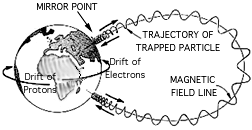
[38] It is here that two things should be noted in regards to physics and magnetospheric physics; Firstly, nuclear explosions from the air are different than ground-based nuclear explosions in many ways (including contamination levels), but the weather and wind direction are major unknowns or variables; Secondly, as a fundamental natural law energy never disappears, it only changes or is transferred. The energy from nuclear explosions can theoretically be transferred into the Earth’ magnetic radiation fields, called the Van Allen Belt or the Van Allen Belts, and used to energize and excite various particles, sub-atomic particles, and ions. Tentatively, if manipulated this can have harmful results on surface areas, including burning electronic and communication devices, and military applications such as disrupting satellites in space. If this were possible Russian, Chinese, Iranian, or Indian military defences, communications, and missile facilities could be effortlessly neutralized.

These radiation belts also travel in loops and notionally an energized pulse set off from an area in the U.S. could circumnavigate into an area halfway around the globe.
In fact the U.S. military has been experimenting with manipulating the radiation belts since the end of the Second World War. The U.S. Navy’s Project Argus, taking place from August to September 1958, is an example. A total of five nuclear weapons were used; three atom bombs (weapons using nuclear fission) were detonated above the Atlantic Ocean and two thermonuclear or hydrogen bombs (weapons using nuclear fusion) in the Pacific Ocean in an effort to manipulate the Van Allen Belts.