Showing posts with label "Africa". Show all posts

Wednesday, November 17, 2010

Food prices may rise by up to 20%, warns UN

Food prices may rise by up to 20%, warns UN

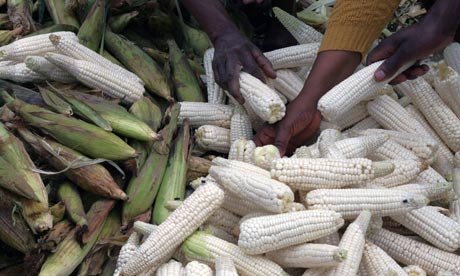
Poor harvests put global food reserves under pressure,
with African and Asian countries likely to be worst hit


Prices of wheat, maize and many other foods traded internationally
have risen by up to 40% in just a few months.
Photograph: Simon Maina/AFP/Getty Images


The UN today warned that food prices could rise by 10%-20% next year after poor harvests and an expected rundown of global reserves. More than 70 African and Asian countries will be the worst hit, said the Food and Agricultural Organisation in its monthly report.

In its gloomiest forecast since the 2007/08 food crisis, which saw food riots in more than 25 countries and 100 million extra hungry people, the report's authors urged states to prepare for hardship.

"Countries must remain vigilant against supply shocks," the report warned. "Consumers may have little choice but to pay higher prices for their food. The size of next year's harvest becomes increasingly critical. For stocks to be replenished and prices to return to more normal levels, large production expansions are needed in 2011."

Prices of wheat, maize and many other foods traded internationally have risen by up to 40% in just a few months. Sugar, butter and cassava prices are at 30-year highs, and meat and fish are both significantly more expensive than last year.

Food price inflation – fuelled by price speculation, the searing heatwave in Russia in the summer and heavy trading on futures markets – is now running at up to 15% a year in some countries. According to the UN, international food import bills could pass the $1tn mark, with prices in most commodities up sharply from 2009.

Extreme volatility in the world markets has taken the UN by surprise and forced it to reassess its forecasts for next year. "Rarely have markets exhibited this level of uncertainty and sudden turns in such a brief period of time. World cereal production this year, which is currently put at 2,216m tonnes, is 2% below 2009 levels, 63m tonnes less than the forecast reported in June," said the authors.

"Contrary to earlier predictions, world cereal production is now forecast to contract by 2% rather than to expand by 1.2%, as anticipated in June," they said.

Global food reserves, which currently stand at around 74 days, are now expected to decrease significantly in the next few months. "Cereal reserves may drop by around 7%, barley nearly 35%, maize 12% and wheat 10%. Only rice reserves are expected to increase, by 6% next year," said the report.

Much now hangs on next year's harvests, it said. "International prices could rise even more if production next year does not increase significantly – especially in maize, soybean and wheat. Even the price of rice, the supply of which is more adequate than other cereals, may be affected if prices of other major food crops continue climbing."

But food analysts said the prospects for a bumper world harvest next year were slim. "2011 will not be a good harvest. The condition of winter wheat crops is not good. Neither the US nor Russia are expecting good harvests," said Lester Brown, founder of the Washington-based Worldwatch Institute.

"The poorest will suffer the most because they feel the effect of price rises directly. In the US and Europe, wheat may only make up 10% of the price of a loaf of bread."

Tuesday, September 28, 2010

Wal-Mart Bids $4.6 Billion for South Africa's Massmart


Wal-Mart Bids $4.6 Billion for South Africa's Massmart


By MIGUEL BUSTILLO in Houston,
ROBB. M. STEWART in Johannesburg
and PAUL SONNE in London


Wal-Mart Stores Inc. made an aggressive but expensive bid to expand in Africa ahead of its international competitors, offering to buy South African retailer Massmart Holdings Inc. for 32 billion rand ($4.6 billion).

Wal-Mart's proposed offer—the company's biggest acquisition in more than a decade—would represent a relatively high premium for Massmart, a 290-store chain operating in 13 African nations.

Yet a deal would give the Bentonville, Ark., giant a critical foothold to expand in Africa and allow Wal-Mart to beat European multinational rivals Carrefour SA, Tesco PLC and Metro AG into the potentially lucrative sub-Saharan market.

Massmart would serve as "a fantastic entry point to a broader part of the continent," said Andy Bond, a former chief executive of Wal-Mart's U.K. subsidiary Asda, who is spearheading the purchase. Massmart already is expanding beyond its South Africa base, Mr. Bond said in an interview Monday.

A shopper left a Massmart chain, the Game store,
in South Gate mall south of Johannesburg, South Africa, on Monday.
Wal-Mart has learned the hard way that a first-mover advantage can be important in international retailing.

Carrefour, Wal-Mart's global archrival, beat Wal-Mart to South America, opening stores in Brazil in 1975, nearly two decades before Wal-Mart. The France-based company also was the first major international chain to establish a presence in Asia, through a joint venture in Taiwan in 1989.

Despite investing billions of dollars building and buying stores, Wal-Mart still trails Carrefour in Brazil today. And Carrefour remains the largest international retailer in China, the most coveted retail market in the developing world. While Carrefour doesn't have sub-Saharan operations, the chain has stores in northern Africa.

Wal-Mart's African foray is risky, however. The offer is roughly 13 times Massmart's pretax earnings and would place Wal-Mart into a politically combustible region.

South Africa is emerging slowly from the recession, is plagued by high crime and unemployment and marked with a heavily unionized work force known for long, sometimes violent, strikes. Other sub-Saharan nations carry even more political risks.

"Massmart is well positioned as a springboard for sub-Saharan Africa, but we believe that it will take a much longer time period for the company to earn its cost of capital in Africa," said Janney Montgomery Scott analyst David Strasser. "For every relatively stable country like Botswana, there is a Zimbabwe."

Nevertheless, Wal-Mart appears prepared to face those risks as it looks to extend its reach in emerging markets and expand its international business, which makes up a fourth of the company's roughly $405 billion in annual revenue.

The international division clearly is Wal-Mart's growth engine, now that sales at U.S. stores open at least a year have fallen for five consecutive quarters. The company is examining entering other emerging markets as well, including Russia and the Middle East. "Wal-Mart is a company that wants to aggressively expand world-wide," Mr. Bond said.


But Wal-Mart hasn't always managed to get its formula right abroad, in part because the retailer sometimes has failed to cater to local habits and markets. Wal-Mart in 2006 abandoned its Germany operation after spending eight years trying to crack the market, one of Europe's most competitive discount-retailing environments. Wal-Mart pulled out of South Korea last decade.

South Africa, particularly Johannesburg and Cape Town, is an attractive prospect, drawing shoppers from Nigeria, Kenya and elsewhere on the continent because of its well developed roads and wide range of retailers, from discount stores to high-end, international brands.

Like Wal-Mart, Massmart operates low-cost, high-volume stores with a strong general retail business and an emerging food operation. Founded in 1990, Massmart operates several chains, including Game general-merchandise stores, Makro warehouse-club stores and Builders Warehouse for construction and home improvement.

Massmart is one of several large chains, including Shoprite Holdings Ltd. and Woolworths Holdings Ltd., that dominate South Africa and have expanded into neighboring countries. Massmart reported sales of 47.55 billion rand in the fiscal year through June, up 10% from a year earlier.

Wal-Mart made a nonbinding proposal that could lead to a cash offer of 148 rand ($21.08) a share for Massmart. The companies said Monday that they are in exclusive negotiations to try to hammer out a deal, which would be subject to regulatory approval.

Massmart's shares closed 11% higher at 149 rand in Johannesburg, giving the company a market value of about 30 billion rand and indicating that Wal-Mart may have to adjust its offer somewhat higher. Wal-Mart shares fell 60 cents to $53.48 in 4 p.m. composite trading on the New York Stock Exchange.

"It is early days," Massmart CEO Grant Pattison said during a conference call. He said his impression is that Massmart's entire management team would be retained in a deal.

Mr. Bond said Wal-Mart, should it close the deal, would support Massmart's existing black economic-empowerment arrangements, and try to enhance them where possible. Companies in South Africa are required to include equity ownership by blacks as part of the government's efforts to reverse years of apartheid rule and bring the majority population into the mainstream economy.


**Write to Miguel Bustillo at miguel.bustillo@wsj.com
and Paul Sonne at paul.sonne@wsj.com **