Showing posts with label 2011. Show all posts

Wednesday, November 17, 2010

Food prices may rise by up to 20%, warns UN

Food prices may rise by up to 20%, warns UN

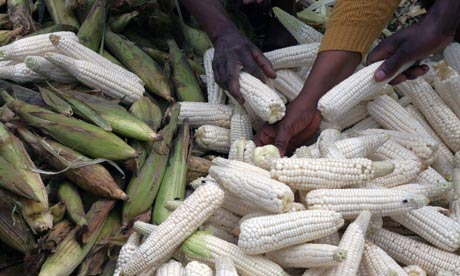
Poor harvests put global food reserves under pressure,
with African and Asian countries likely to be worst hit


Prices of wheat, maize and many other foods traded internationally
have risen by up to 40% in just a few months.
Photograph: Simon Maina/AFP/Getty Images


The UN today warned that food prices could rise by 10%-20% next year after poor harvests and an expected rundown of global reserves. More than 70 African and Asian countries will be the worst hit, said the Food and Agricultural Organisation in its monthly report.

In its gloomiest forecast since the 2007/08 food crisis, which saw food riots in more than 25 countries and 100 million extra hungry people, the report's authors urged states to prepare for hardship.

"Countries must remain vigilant against supply shocks," the report warned. "Consumers may have little choice but to pay higher prices for their food. The size of next year's harvest becomes increasingly critical. For stocks to be replenished and prices to return to more normal levels, large production expansions are needed in 2011."

Prices of wheat, maize and many other foods traded internationally have risen by up to 40% in just a few months. Sugar, butter and cassava prices are at 30-year highs, and meat and fish are both significantly more expensive than last year.

Food price inflation – fuelled by price speculation, the searing heatwave in Russia in the summer and heavy trading on futures markets – is now running at up to 15% a year in some countries. According to the UN, international food import bills could pass the $1tn mark, with prices in most commodities up sharply from 2009.

Extreme volatility in the world markets has taken the UN by surprise and forced it to reassess its forecasts for next year. "Rarely have markets exhibited this level of uncertainty and sudden turns in such a brief period of time. World cereal production this year, which is currently put at 2,216m tonnes, is 2% below 2009 levels, 63m tonnes less than the forecast reported in June," said the authors.

"Contrary to earlier predictions, world cereal production is now forecast to contract by 2% rather than to expand by 1.2%, as anticipated in June," they said.

Global food reserves, which currently stand at around 74 days, are now expected to decrease significantly in the next few months. "Cereal reserves may drop by around 7%, barley nearly 35%, maize 12% and wheat 10%. Only rice reserves are expected to increase, by 6% next year," said the report.

Much now hangs on next year's harvests, it said. "International prices could rise even more if production next year does not increase significantly – especially in maize, soybean and wheat. Even the price of rice, the supply of which is more adequate than other cereals, may be affected if prices of other major food crops continue climbing."

But food analysts said the prospects for a bumper world harvest next year were slim. "2011 will not be a good harvest. The condition of winter wheat crops is not good. Neither the US nor Russia are expecting good harvests," said Lester Brown, founder of the Washington-based Worldwatch Institute.

"The poorest will suffer the most because they feel the effect of price rises directly. In the US and Europe, wheat may only make up 10% of the price of a loaf of bread."

Wednesday, October 6, 2010

IMF warns global recovery might not be sustained

IMF warns global recovery might not be sustained

By Agence France-Presse, Updated: 10/6/2010


Rich and emerging economies must dramatically change the way they trade with each other or risk throttling the global economic recovery, the International Monetary Fund warned on Wednesday.


In its latest economic outlook, the IMF said growth would slow more than previously expected in 2011, as the United States, Europe and Japan continue to struggle and China remains overly dependent on exports.

The recovery is "neither strong nor balanced and runs the risk of not being sustained," warned Olivier Blanchard, the IMF's chief economist.

Painting a picture of a faltering developed world -- where business is still struggling to pick up where government crisis spending left off -- the IMF predicted global growth would be pared back to 4.2 percent next year.

That is less than the 4.8 percent growth expected this year and 0.2 point below the IMF's July forecast for 2011.

While restocking had helped short-term growth in the United States, Japan and some parts of Europe, the IMF said advanced economies were still reliant on dwindling government spending.

"For the past year or so, inventory accumulation and fiscal stimulus were driving the recovery. The first is coming to an end. The second is slowly being phased out," the IMF said in its twice-yearly World Economic Outlook.

The IMF slashed its US growth forecast for 2011, to 2.3 percent, lopping 0.6 points off its July forecasts.
The growth forecast was also trimmed for this year, down 0.7 points to 2.2 percent, with warnings of "a weak recovery in coming quarters."

The IMF recommended that some central banks, like the US Federal Reserve, continue their ultra-loose monetary policies, but warned the impact of such policies would now be limited.

"Not much more can be done, and one should not expect too much from further quantitative or credit easing."

Increased exports must take up the slack, it added.

"Many advanced economies, most notably the United States, which relied excessively on domestic demand, must now rely more on net exports."

Meanwhile the IMF said that rich countries, many of which are heavily in debt, would have to trim spending and balance their books in the medium term.

"Fiscal stimulus has to eventually give way to fiscal consolidation, and private demand must be strong enough to take the lead and sustain growth."

There was a particular warning for Europe, with "severe external financing constraints" forecast for debt-laden Greece, Ireland, Portugal and Spain.

The picture could not be more different for emerging markets like India and China, where growth continues, but is limited by an over-dependence on exports to Europe, Japan and the United States that must be addressed.

"Emerging market economies with large current account surpluses must accelerate rebalancing. This is not only in the world economy's interest, but also in their own."

Wading into sensitive political waters, the IMF said China must allow its currency to strengthen to boost domestic demand and reduce its reliance on exports.

"To the extent that a stronger Chinese currency eases this process, other surplus countries in the region could follow suit, which would facilitate the needed shift towards domestic sources of growth," the IMF said.

Emerging markets are expected to expand at a rate of 7.1 percent this year and 6.4 percent in 2011.

Advanced economies are expected to grow more slowly, at 2.7 percent in 2010 and 2.2 percent next year.

The WEO report came ahead of Friday's opening of a two-day annual meeting of the IMF, where its 187 member nations are set to focus on a looming currency war and the dangers of protectionist trading policies.